Hybrid Human–AI Careers: Skills, Resumes, 30-Day Plan

What’s Changing: Jobs Aren’t Disappearing, Tasks Are Rebalancing
AI is moving through workplaces the same way spreadsheets once did: not by erasing entire professions overnight, but by reshaping the most common workflows inside them. The practical shift is from “Who does this job?” to “Which parts of this workflow can be automated, which parts are enhanced, and which parts still require human judgment?” For more guidance, see [PDF] Artificial Intelligence and the Future of Teaching and Learning (PDF).
Automation and augmentation look similar on the surface—faster drafts, quicker analysis, fewer manual steps—but the career impact is different. Automation replaces specific tasks; augmentation increases the value of the person who can frame the problem, choose constraints, validate outputs, and communicate decisions with context. That’s why “AI-proof” roles are rare. Most roles become “AI-shaped,” where tool fluency is expected and human oversight becomes a defining responsibility. For further reading, see Leveraging AI, Change Management, and Process Improvement to ….
Early signals show up before job titles change: cycle times compress, handoffs decrease, outputs become more standardized, and “Can you use the tools?” becomes table stakes. To spot your best move, map your role as a workflow (inputs → decisions → outputs) and label each step by how likely it is to be automated versus elevated.
| Task type | What AI can do well | Human advantage | Career move to consider |
|---|---|---|---|
| Routine & repeatable | Draft, classify, summarize, extract | Define standards, catch edge cases | Shift toward quality control, governance, or process ownership |
| Analytical with clear rules | Pattern detection, forecasting, optimization | Frame the question, choose constraints | Add domain specialization and decision accountability |
| Creative & exploratory | Generate variations and alternatives | Taste, narrative coherence, brand fit | Build a portfolio showing direction + iteration management |
| High-stakes & people-centered | Prepare briefs, scripts, checklists | Trust, ethics, negotiation, empathy | Move into client-facing leadership with AI-enabled prep |
Hybrid Human–AI Roles: Where Opportunity Concentrates
Hybrid roles sit at the intersection of tool operation and real accountability. The tools can accelerate output, but the human owns the intent and the consequences: what gets prioritized, what gets trusted, what gets escalated, and what gets shipped.
Common archetypes are already emerging across industries: AI-enabled analysts who turn messy questions into measurable decisions, AI operations coordinators who keep quality and compliance intact, workflow designers who create reliable automations with exception handling, content strategists who run AI production pipelines without brand drift, and customer success leaders who pair AI support systems with human judgment.
Hiring managers don’t just want “AI experience.” They look for candidates who can translate business goals into workflows, evaluate outputs, and document decisions in a way that others can repeat. The fastest way to stand out is to show method: prompts (or instructions), checklists, rubrics, versioning habits, and how you decide when to trust the model versus when to override it.
Future-Proof Skills That Compound (Even as Tools Change)
Tools will churn; durable career leverage comes from skills that help you use any tool responsibly. The most resilient bets are:
- Problem framing: turning vague requests into measurable objectives with constraints and tradeoffs.
- Critical evaluation: verifying sources, spotting hallucinations, and stress-testing assumptions.
- Data literacy: cleaning, labeling, interpreting, and communicating data without overclaiming certainty.
- Communication under ambiguity: writing clear briefs, aligning stakeholders, and making decisions visible.
- Ethics and risk thinking: privacy, bias, IP concerns, and escalation paths when outputs are wrong or sensitive.
- Workflow building: combining tools, templates, and checkpoints into systems that produce consistent results.
These skills transfer across roles because they are about how work is governed. They also align with the trajectory described in major labor and economics research, including the World Economic Forum’s Future of Jobs Report and the OECD’s work on AI and the future of work.
Resume Strategies for AI-Shaped Hiring
Resumes win when they show outcomes first and the system behind them second. A strong hybrid bullet typically follows: result → method → tools → safeguards. This keeps the focus on business value while proving you understand reliability, risk, and collaboration.
A 30-Day Career Impact Plan: Move From Curiosity to Credibility
Week 1: Pick one workflow and define success
Week 2: Build the repeatable system
Week 3: Validate and document
Week 4: Package for hiring
When to Upskill vs. Pivot: A Simple Decision Guide
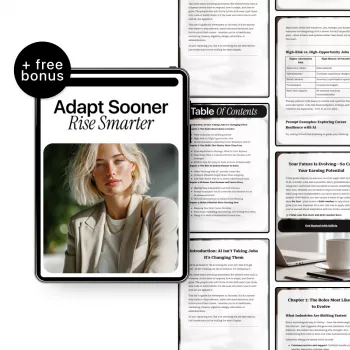
For deeper, step-by-step guidance and ready-to-use resume language, see the Adapt Sooner Rise Smarter eBook. Creatives building hybrid portfolios can also sharpen their visual iteration process with Prompt Like a Pro, See Like a Visionary – Midjourney Prompt Guide for Creators.
FAQ
What are hybrid human–AI roles?
Hybrid human–AI roles are positions where AI tools handle parts of the workflow, while the human owns problem framing, validation, ethics, stakeholder alignment, and final decisions. Examples include AI-enabled analysts, workflow designers, AI ops coordinators, and content strategists running AI production pipelines. Hiring teams want evidence of repeatable methods, QA steps, and accountable outcomes.
How can a resume show AI capability without sounding vague?
Use outcome-first bullets that describe a specific workflow you built or improved, the evaluation steps you used, and the safeguards you added (review checkpoints, metrics, escalation rules). Mention artifacts like templates, rubrics, SOPs, and decision logs instead of generic tool lists. Specificity signals you can deliver reliable results, not just experiment.
Which skills are safest to build as AI changes quickly?
Compounding skills include problem framing, critical evaluation, data literacy, communication under ambiguity, ethics/risk thinking, and workflow design. These transfer across tools because they govern how work is defined, checked, and trusted. As platforms shift, the ability to create reliable systems and defend decisions remains valuable.










Leave a comment