Launch a Side Hustle Fast: MVP, Funnel, Pricing, First Sales

Side Hustle Launch Playbook: MVP, Funnel, Pricing, and First Customer Tactics
A low-risk side hustle becomes real when it moves from “idea” to a paid offer with a clear next step. The fastest path isn’t building a perfect website or polishing a brand—it’s shipping a minimum viable product (MVP), setting up a simple sales funnel, choosing pricing you can test quickly, and landing the first customers without overbuilding or overspending.
Start With a Problem Worth Paying to Solve
Strong side hustles start with a specific customer and a specific outcome. Vague audiences create vague offers—and vague offers don’t convert.
- Pick a narrow customer type: role + situation + desired outcome (e.g., “busy Etsy sellers who need better product photos”).
- Write a one-sentence promise: outcome + timeframe + constraints (low time, low cost, no new tools if possible).
- List 10 pain points and rank them by urgency, frequency, willingness to pay, and your ability to deliver fast.
- Match format to the problem: template, checklist, short consult, done-for-you starter package, mini-course, or simple digital download.
- Define the MVP’s measurable result: “complete X,” “save Y minutes,” or “generate Z leads”—not “learn about…”
Design an MVP That Can Be Built in Days, Not Weeks
An MVP is the “thin slice” that proves demand and delivers a real outcome—without extra features. The goal is version 1.0 that customers will pay for, not a final masterpiece.
- Thin slice the offer: one core feature, one core outcome, one core customer segment.
- Use a 3-part structure: (1) quick win, (2) repeatable process, (3) simple next steps.
- Pre-sell before polishing: a landing page + checkout + delivery method is enough to validate demand.
- Choose low-complexity delivery: PDF, Google Doc, Notion template, Loom walkthrough, or a 30–60 minute live session with replay.
- Set acceptance criteria: what “done” means for v1.0—and what gets delayed to v2.0.
Build a Simple Sales Funnel That Doesn’t Need Ads
For a new side hustle, complexity is the enemy. Keep your funnel so simple that you can run it from a phone if needed.
- 3 steps only: traffic source → offer page → checkout + delivery.
- Pick one primary traffic source for 14 days: a community, marketplace, social platform, or direct outreach.
- Create a lead magnet only if it supports the paid offer: an audit checklist that naturally leads to your implementation kit or service.
- Use one call-to-action everywhere: “Buy,” “Book,” or “Request the starter pack.” Avoid multiple competing actions.
- Add trust fast: 3 proof elements (credentials, before/after, testimonials, or sample pages). No testimonials yet? Use previews and a clear guarantee.
One-Page Funnel Components (Minimal Setup)
| Funnel step | What it includes | Tool-light option |
|---|---|---|
| Offer page | Clear promise, who it’s for, deliverables, proof, FAQs | One-page site builder or a single long-form page on a storefront |
| Checkout | Price, payment method, refund policy, confirmation | Storefront checkout or payment link |
| Delivery | Instant download or scheduling link + onboarding | Auto-email with file link or calendar invite |
Pricing That Encourages Fast Testing (Without Undervaluing)
Early pricing should be simple, testable, and anchored to outcomes. The price is part of the positioning—so tweak it with intention, not panic.
Starter Pricing Menu (Adaptable to Most Side Hustles)
| Option | Best for | Typical range | What to include |
|---|---|---|---|
| Starter | New buyers who want a quick win | $9–$29 | Checklist/template + short guide + examples |
| Standard | Buyers who want the full result | $39–$99 | Full MVP kit + walkthrough + implementation steps |
| Premium | Buyers who want help applying it | $149–$499 | Kit + 30–60 min call or light customization |
First Customer Tactics That Work With Low Time and Low Budget
Measure What Matters in Week One
Scale Carefully: Add One Lever at a Time
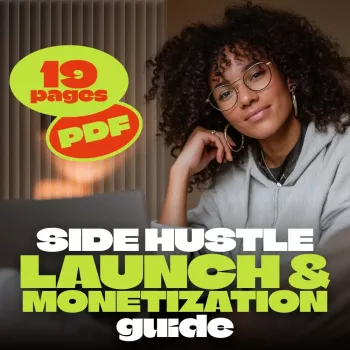
What’s Included in the Side Hustle Launch & Monetization Guide
If a step-by-step structure helps you move faster, the Side Hustle Launch & Monetization Guide is built around the exact sequence above—so you can go from idea to a sellable first version without overthinking.
Helpful add-ons for momentum and execution
- Prompt Like a Pro, See Like a Visionary – Midjourney Prompt Guide for Creators (useful if your side hustle relies on fast creative production and consistent visuals).
- Daily Affirmations for Abundant Wealth | Audio Course (a simple routine for staying consistent when results are still early).
Smart compliance basics for selling online
As you collect payments and market an offer, keep your setup simple and compliant. The U.S. Small Business Administration’s planning resources are a solid starting point, and the FTC’s advertising and marketing basics help you avoid risky claims, unclear pricing, or misleading testimonials.
FAQ
How fast can an MVP be launched for a side hustle?
Most MVPs can launch in 2–7 days if you keep scope tight and skip polish. The minimum is an offer page, a checkout method, and a delivery flow (download link or scheduling link) that customers can use immediately.
What if the first version doesn’t sell?
Diagnose before rebuilding: test whether the channel is wrong, the promise/proof is unclear, or the pricing/framing is off. Run small experiments (new headline, stronger preview, clearer deliverables, different outreach list) and set a stop rule after 7–14 days if there’s no interest and no sales.
Do tiers or subscriptions help early on?
Early on, one clear price usually converts best and is easier to test. Tiers make sense after you see consistent demand and clear buyer segments; subscriptions are often premature unless you can deliver ongoing value reliably every month.








Leave a comment